
Underfloor Heating or Radiators..?
- Phil Speak
- Dec 29, 2020
- 4 min read
Updated: Jan 2, 2021
Many of our customers ask us to advise us on the difference between using underfloor heating or radiators on their project. In this article we give you the pro's and cons of each system which should help you to decide what is best for you.

Traditional Radiators
Most of us have experience of living with modern radiators so we understand how they work and what the pro's and cons of them are, but lets run through them here to remind ourselves.
Whilst the majority of the radiators fitted in the UK will be a 'wet system' and connected to a boiler, not all will be. There is the option to use electric radiators which could be fan convectors or oil filled. There may also be some storage heaters knocking about for the 70's but we will discount them from this article as not many people would consider installing them today.
In essence either 'wet' or 'dry' (electric) radiators are much the same. they are stell wall mounted panels with some degree of control. They are all capable of heating a room quickly, certainly within 30 minutes so in that sense they are very flexible. They can also can be easily controlled either centrally from the boiler if its a wet system or on the radiator itself.
Modern radiators are also very efficient pumping out lots of heat when compared to their counterparts of thirty or forty years ago. In terms of aesthetics, there are now many options compared to the limited options in the past. For example a period property may benefit from the look of a 'cast iron' look radiator as shown below as this will add to the overall character you are wanting to create.
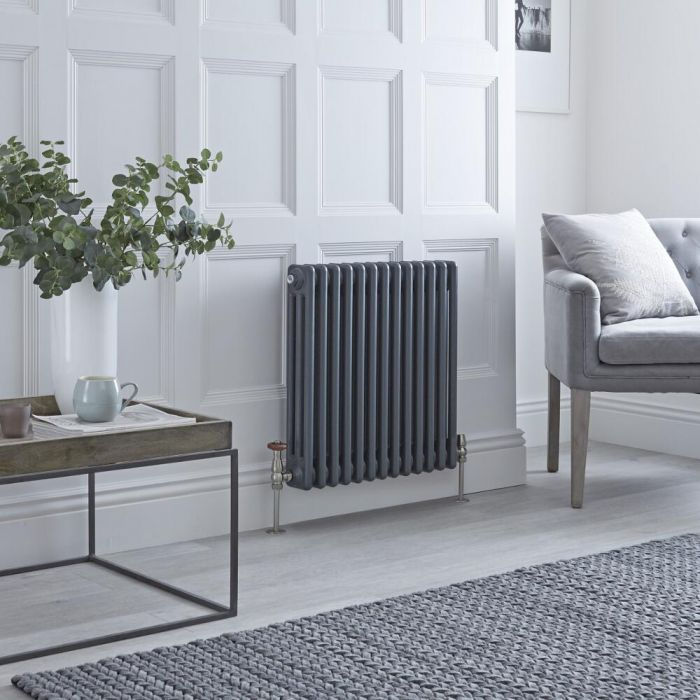
If you prefer a more contemporary look you can opt for one of the many modern vertical radiators on the market (see below) which can be bought in a huge range of colours and become a focal point in a contemporary space. The final solution is to use the traditional steel paneled radiators and if you want to hide them there are a number of decorative boxings that can be used.
So to sum up, radiators offer the following benefits:
Controllable - Quick to warm up and cool down
Flexible - Can be installed anyway and in any building
Efficient - Cheap to run
Aesthetics - can add to the character of the building
But the following may cause a problem:
Space - They take up wall space and can influence furniture layout
Aesthetics - Some people do not like to look at them
Heating - Don't always give an even distribution of heat

Underfloor Heating
Underfloor heating has become more popular in recent years and has become a 'must have' in modern luxury open plan homes. Like radiators there are two options, a dry system (an electric mat with wires) or a wet system (water filled pipes connected to the boiler).
The dry system is ideal for small spaces such as bathrooms, kitchens and small extensions, it is reasonably cheap to buy and easy to install. The wet system is more difficult to install in some respects as it involves raising the floor by at least 15mm. Both systems work better under ceramic tiles as they are good conductors of heat and less well under timber floors and carpets.
Wet systems run at a much lower temperature than radiator systems, the water in radiators will typically be 85 degrees but in underfloor heating it will run at around 55 degrees. This means much greater warm up times which will typically be a few hours not a few minutes, and cool down times will be longer too.
Generally underfloor heating is operated differently to radiators, you might leave Underfloor heating on constantly with the thermostat set to a comfortable temperature and allow the sensors to control it rather than controlling it via a timer as with radiators. The controllers can be preset so that your daytime temperature is higher than your nighttime temperature.
With wet systems the pipes would ideally be set into a screed. Whilst this might be good for new builds it can be troublesome for refurbishments. However, many manufacturers now offer an 'overlay' type system which can be as little as 15mm thick and is therefore easier to retrofit which makes it easier to be incorporated into existing buildings.
Underfloor heating can be a great solution in new builds or full conversions, it is discreet, provides an even distribution of heat and and free's up wall space. It may be more expensive to install than radiators but that difference is reducing all the time and having it could be seen as a positive when you come to sell your house.
So here are the pro's of underfloor heating:
It is discreet and does not impact on furniture layouts
It can be seen as a 'must have' for the resale of certain properties
It heats your house evenly and eliminates cold spots.
It allows you to maintain a constant temperature throughout the day.
The cons could be seen as:
It is not easily controlled when compared to radiators.
It does not work so well in older un-insulated properties
It can be more costly to install especially in older buildings
It reduces your choice of floor coverings.
Our Advice - Consider using underfloor heating downstairs and radiators upstairs for the best of both worlds and control where you need it most.


Comments